Cape Town’s Loop Street is lined with buildings that form part of the city’s historic…
The unseen engineering behind Mary Sibande’s Monument to an Absence
When visitors encounter Mary Sibande’s striking Monument to an Absence at the South African Reserve Bank Museum in Pretoria, their attention is naturally drawn to the artwork itself.
What they do not see is the considerable amount of engineering, handling, transport, planning and installation work required to get a monumental sculpture of this nature safely into its final position.
That was where Grandi Manufacturing came in.
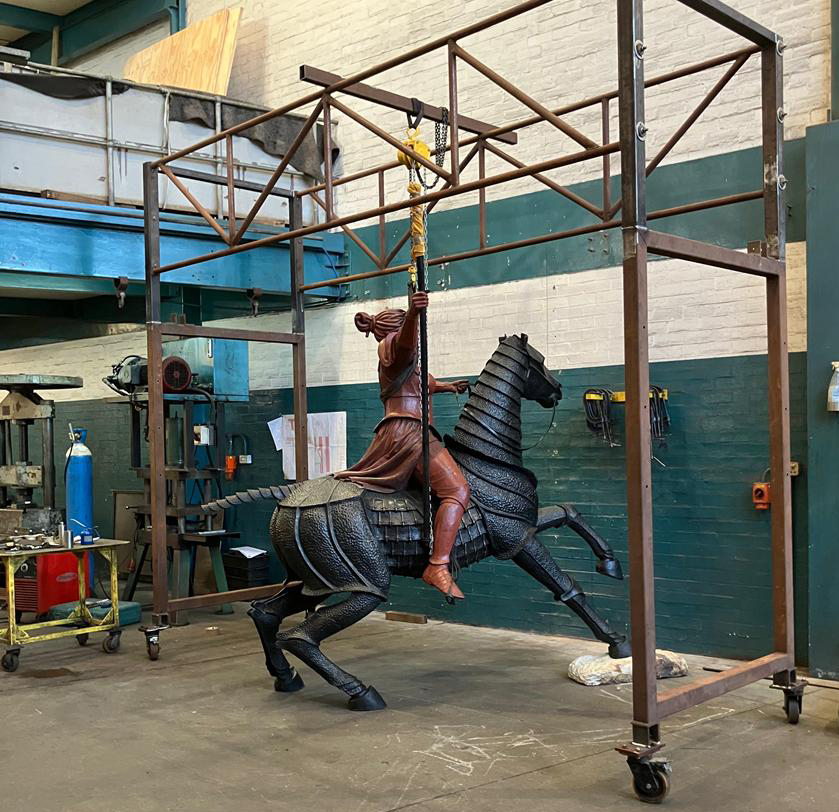
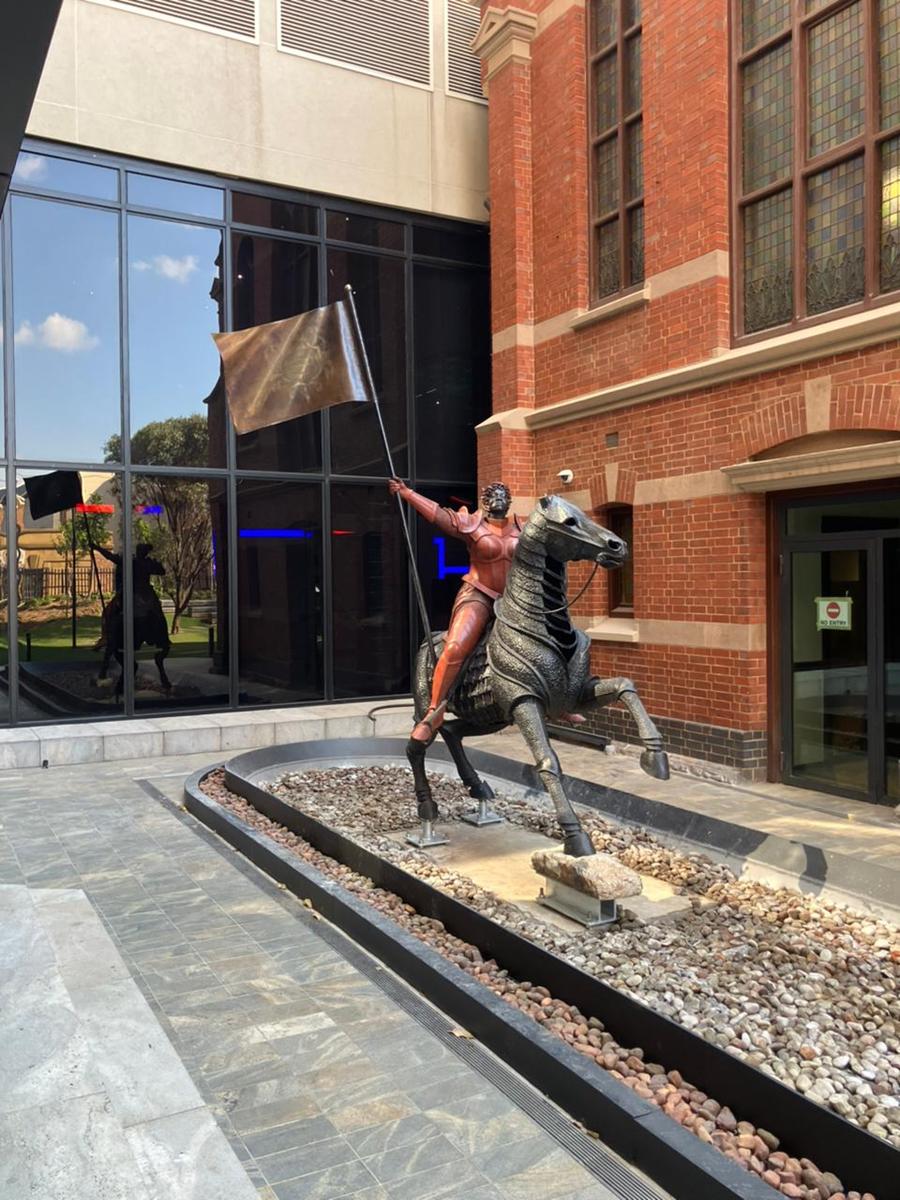
Created in 2024 by acclaimed South African artist Mary Sibande, Monument to an Absence was commissioned for the South African Reserve Bank Museum. The imposing work depicts a powerful red female figure astride the skeletal, armoured form of a horse, deliberately reworking the conventions of the traditional equestrian monument.
Sibande explained at the opening of the museum that she had been exploring what monuments represent and whose stories they preserve. Rather than presenting a conventional heroic rider on a solid horse, she stripped the animal back so that its skeletal structure remains visible. The work addresses absence not only through the horse, but through the people and histories that have themselves been absent from traditional public monuments.
For Grandi Manufacturing, however, the challenge was a highly practical one: how do you transport, support, position and permanently secure a large, complex artwork while preserving exactly the pose and visual effect intended by the artist?
From Cape Town to Pretoria
Grandi’s involvement extended well beyond simply arriving at the Reserve Bank and putting the sculpture into place.
The work first had to be carefully handled and prepared for transport from Cape Town to Pretoria.
Moving an artwork of this scale is no small undertaking. Unlike a conventional steel structure, a finished sculpture cannot simply be treated as another heavy load. Every lifting point, contact area and movement has to take the integrity and finish of the artwork into account.
The sculpture’s dramatic stance added another layer of complexity. The horse is deliberately represented in a dynamic position, with the rider high above it and the weight of the overall composition carried through relatively specific points of contact.
During handling and preparation, Grandi therefore had to ensure the sculpture remained properly supported and stable while it was lifted, moved and prepared for its journey north.
Engineering the anchoring system
Marco Grandi described Grandi Manufacturing’s principal technical role as the “installation and engineering of the anchoring system”.
That anchoring system was critical.
A monumental sculpture must be able to remain permanently in the exact position intended by the artist while safely resisting its own weight and the forces acting on it in its installed environment.
The challenge was therefore not simply to bolt an object to the ground. The team had to understand how the sculpture carried its load, how it needed to be supported and where the permanent anchoring points could be introduced without interfering visually with the artwork.
The resulting support and anchoring solution had to provide structural stability while remaining as discreet as possible.
It is precisely the kind of engineering that is meant to disappear once the installation is complete.
Positioning the sculpture
Once the sculpture reached the South African Reserve Bank, the next challenge was positioning it accurately within the museum garden.
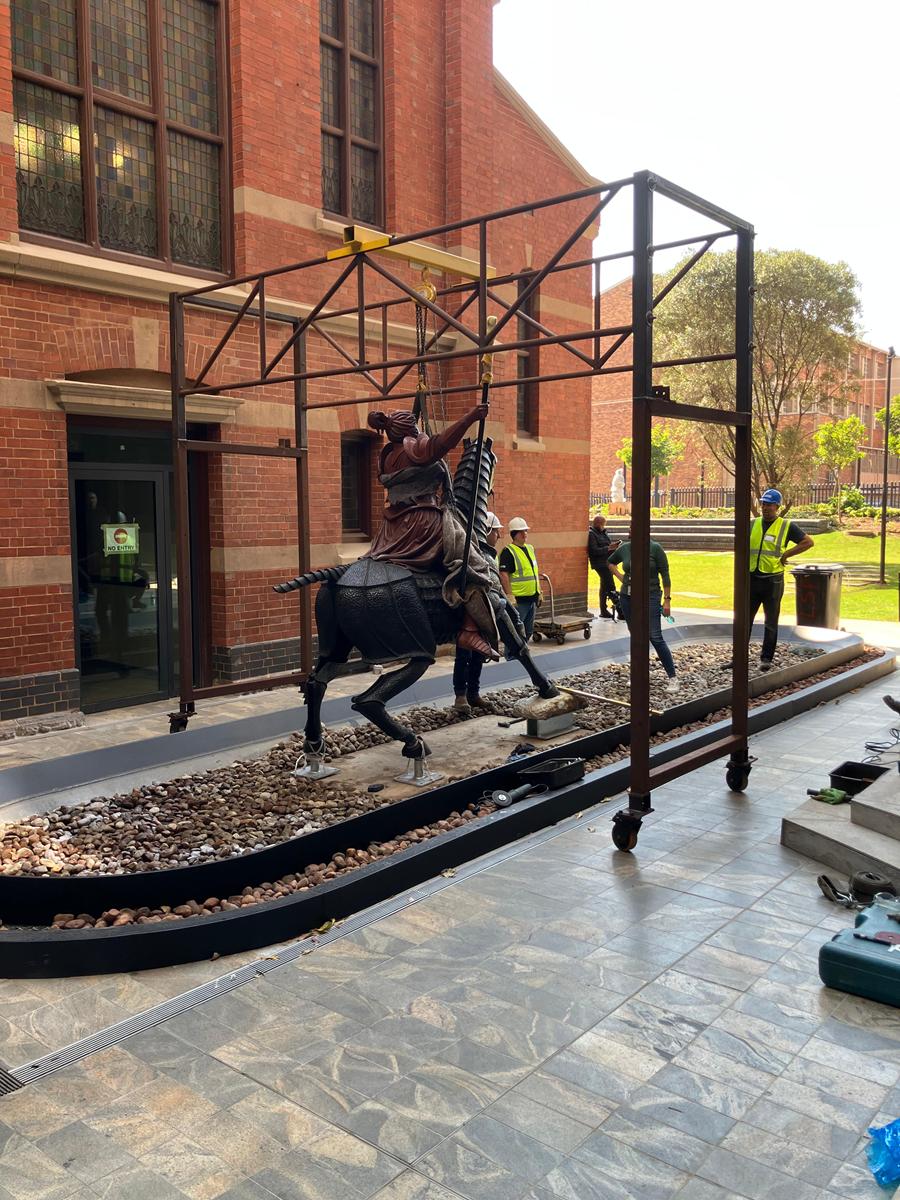
The installation photographs show just how carefully controlled this stage needed to be. Specialist lifting equipment was used to take the weight while the sculpture was manoeuvred and its position adjusted.
This was not simply about getting it approximately into place. The orientation, level and final stance all formed part of the finished artwork.
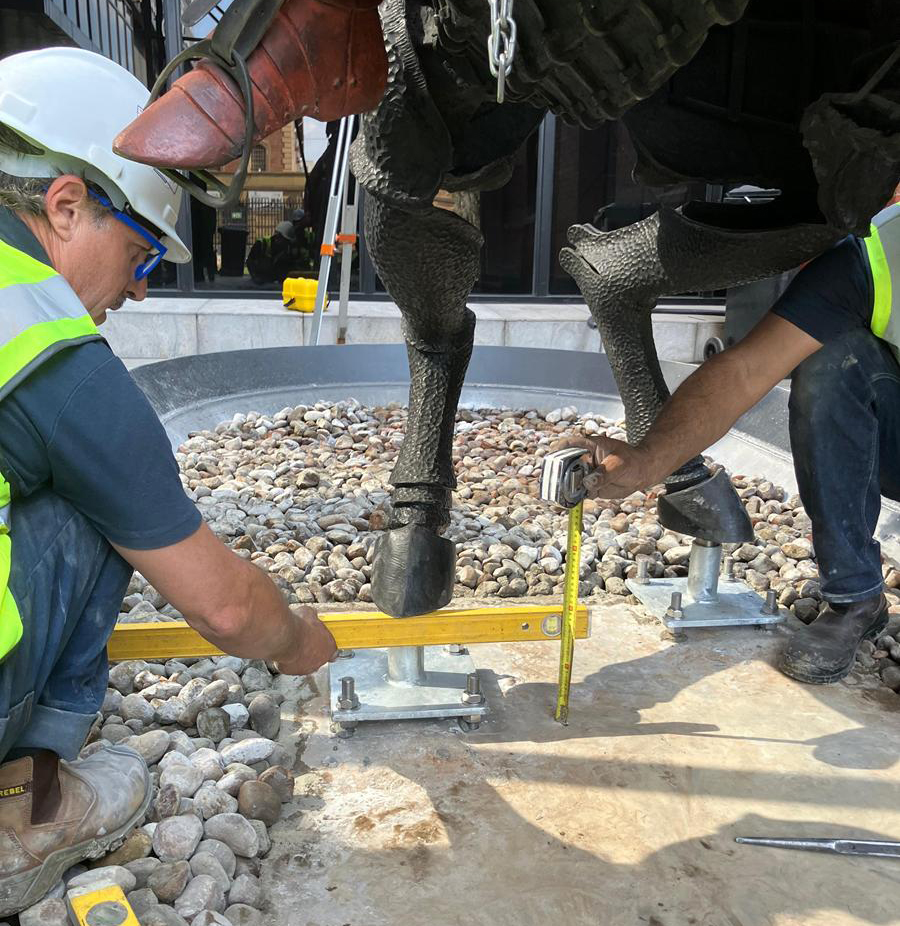
Grandi’s team had to progressively support, position and stabilise the sculpture before the permanent anchoring could be completed.
Only once the team was satisfied that the work was correctly positioned and structurally secure could the temporary lifting and support arrangements be removed.
Solving the details no visitor will ever notice
One of the smaller details of the installation illustrates particularly well the kind of practical problem-solving involved.
The feet or hooves of the sculpture are sealed components. The finished installation meant that water could collect around the base area, so simply allowing those sealed feet to remain standing directly in water was not an acceptable long-term solution.
Grandi therefore incorporated discreet stand-off supports beneath the relevant contact points, keeping the sealed sections of the sculpture out of standing water while maintaining the visual impression intended for the work.
It is a tiny detail in comparison with the overall sculpture, but exactly the sort of detail that matters in a permanent installation.
The public should never need to notice it.
When engineering supports art
Grandi Manufacturing did not create or cast Monument to an Absence. Our contribution was the work behind its successful physical installation: transport, handling, structural support, the engineering of the anchoring system, careful positioning, stabilisation and final installation.
It is a project that perfectly illustrates an aspect of Grandi Manufacturing’s work that often remains unseen.
For more than 50 years, the company has applied practical engineering and metal manufacturing expertise across industrial, architectural, marine and highly specialised projects. Sometimes that means manufacturing an entire structure. On other occasions, it means solving the complex technical challenges that allow somebody else’s extraordinary creation to stand exactly where it was intended.
In Monument to an Absence, the artwork is deliberately concerned with presence, absence, support and what remains unseen.
There is something fitting about the fact that much of the engineering behind it is unseen too.
Visitors to the South African Reserve Bank Museum should see Mary Sibande’s sculpture, not the mechanisms holding it securely in place.
For Grandi Manufacturing, that is a job well done.
Related Posts